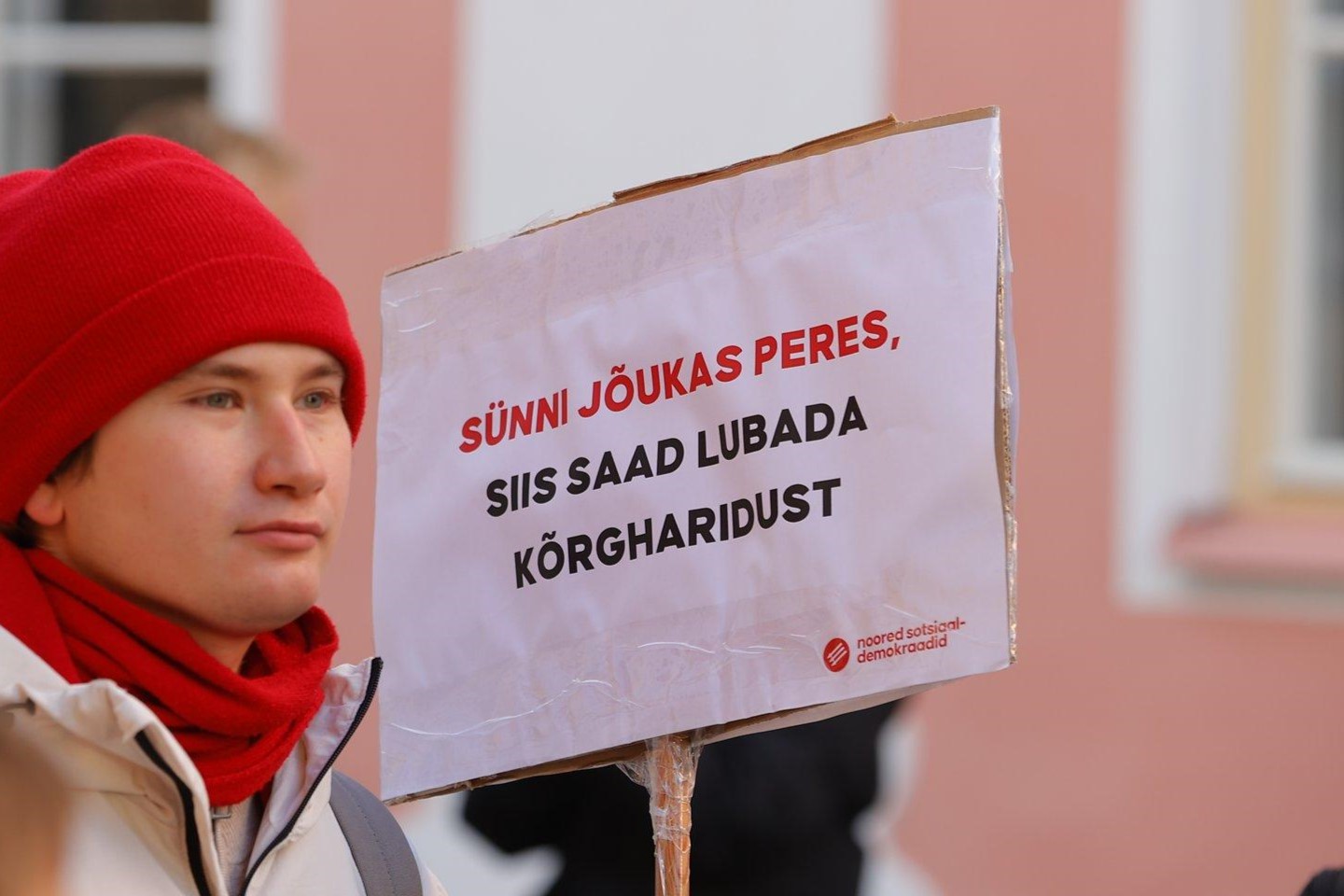
Students from all over Estonia gathered for a picnic in front of Tallinn's Stenbock House to remind the government of the importance of maintaining access to free higher education.
The Union of Estonian Student Unions named the reason for the picket on 17 October as the possibility that the state plans to abolish free studies in Estonian-language curricula and completely eliminate performance scholarships, which has emerged in recent weeks.
The latter is included in next year's national budget.
"These changes would not only threaten our education system, but also have wider social and economic consequences," the union pointed out.
The Union of Students' Unions considers merit scholarships an important source of motivation for students. "This small amount of support helps to recognise and value the results achieved during their studies and, in many cases, to simply make ends meet. Considering that the amount of the merit scholarship has remained the same since 2013, one would expect the government to increase the scholarship, which has been hit by inflation and the rising cost of living, but on the contrary, it wants to abolish the merit scholarship altogether," the association said.
In the current, already inadequate student support system, the Union believes that the abolition of merit scholarships would mean more than simply failing to recognise students' commitment. "For many students, it would also mean the loss of the income that has enabled them to make ends meet," the union added.
The Union of Students' Unions believes that if free higher education disappears, there is a high risk of a brain drain to the Nordic countries, where there is free higher education and a strong support system.
"This would mean the gradual disappearance of higher education and research in Estonian and a decline in the education of society. This would go directly against the country's strategy, which states that we want half of the population to be highly educated," the union wrote.
The abolition of free tuition and merit scholarships will not only affect students, but society as a whole, says the Union.
"Reduced access to education increases social inequalities, as lower income families are unable to send their children to higher education. This creates a situation where the quality of education and opportunities depend more on the financial means of parents than on the potential of the young adult, especially given the changes to the tax system from next year, which will have the greatest impact on low-income families," the union stressed.
The picquet took place in front of the Stenbock House in Tallinn.
Photo by Andres Putting/Delfi Media
Source: postimees.ee