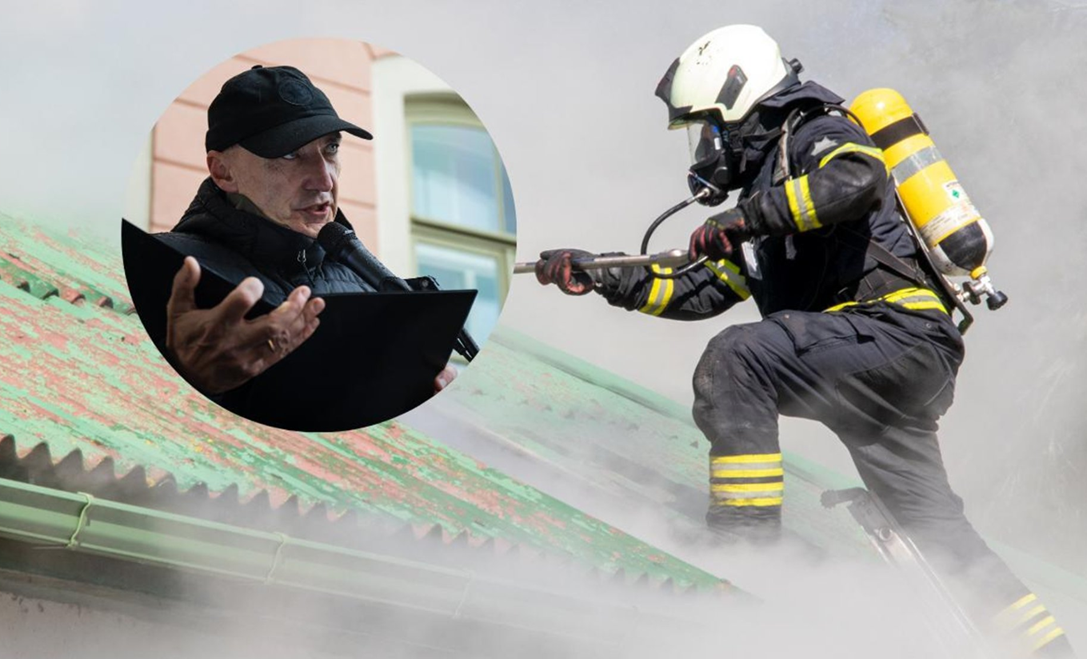
Kalle Koop, EPTAU's chief administrator, writes that the abolition of the tax hike and similar proposed measures would offer no relief to rescuers.
On the second of September, a large crowd of rescuers, police officers, rescue workers and teachers gathered in front of the Stenbock House. It was not a street festival or a procession of celebrations, although the statements of some politicians gave the impression that they did not fully understand the reason for the demonstration. We gathered to draw politicians' attention to our unfairly low wages and the real threats they pose to Estonia's security and education.
It is obvious that if there is no fair pay - and this situation is likely to continue - we will soon no longer have enough rescuers and police officers to come to the rescue in an accident or crisis. There will also be no emergency operators to take calls from people in need.
This means more property damage, more deaths and more injuries. Also even higher costs to the health system, less tax revenue and, to put it a little cynically, fewer taxpayers ... . At the same time, the risks to the responders themselves would be greatly increased, as the teams are critically small and the additional resources that come to the rescue respond at even greater distances than today.
Rest assured that this is not a situation that any of us want to be in. What are the politicians' solutions to the internal security pay problem?
Eliminating tax hikes - the wrong medicine for the right diagnosis
Politicians are proposing the abolition of the tax spiral as a solution. Sound logical? No, it certainly doesn't. The tax hike will be abolished for all Estonian workers, and the salaries of rescuers and policemen will remain as poor as the Estonian average. What is more, as the Estonian average wage continues to rise rapidly, the income of lifesavers will continue to fall in relation to it, and our wage position and competitiveness in the labour market will deteriorate further.
The result? Pressure to leave continues to grow and the staff crisis is deepening.
Two years of "freezing" have done their job
The "unprecedented pay rise" of 2023 (as it was dubbed in the media) will be completely reset two years later. Today's salaries of firefighters are probably the worst in the last 10 years, with police officers and rescue workers in a similar situation. Small pay rises - and politicians have offered such solutions - would disappear like a drop in the ocean. They would not even cover the loss of real purchasing power due to inflation. This in a context where the workload, responsibilities and risks of our people are steadily increasing, with no end in sight.
"There might be some pay rise"
Politicians' cautious statements include the phrases "some wage increase", "a small wage increase", etc. All of this suggests that the seriousness of the problem and its true scale is still not understood, or is deliberately sought to be minimised. This attitude is in flagrant contradiction with one of the main objectives of the coalition agreement, which is to make Estonia one of the safest countries in Europe.
Let me repeat here what the internal security officers are demanding: rescuers and rescue workers expect the average Estonian salary by 2026, police officers 1.2 times the average Estonian salary. Any talk of a tiny pay rise of some kind is obfuscation, misleading and, in fact, a distraction from the problem.
However, linking the chronically underpaid internal security to the need to cut salaries is short-sighted and downright (life-)threatening! There can be no savings (read: profligacy) at the expense of life-savers, it is too high a price to pay, which, considering the consequences, hardly any of us are willing to pay. Or if we do, it will only be in words.
NATO sees the bigger picture - does Estonia?
At the NATO summit in June 2025, it was agreed to increase defence spending to 5%, with 1.5% of this going to non-military defence. Estonia should lead by example and follow the agreement, as national defence is a comprehensive system and internal security/defence is an integral part of it. These concepts are directly linked to a sense of security, which in turn is a fundamental right and need of every human being.
What use is even the most modern military equipment if cities and towns burn down because there are too few rescuers? What use are large stocks of ammunition if there is no one to evacuate or rescue the population in a crisis?
National defence is made up of military and non-military defence, and the two need to be developed in synchrony, on a common basis and through a common financing instrument. In fact, a start has already been made in this direction, with the adoption of the Civil Crisis and National Defence Act, which regulates the peacetime and wartime organisation of national defence and brings together the above-mentioned defence components into a single entity.
However, non-military defence must not be neglected today, and the 2026 national budget must take this principle into account! What is important is not the philosophical breadth of national defence, but the coherence of national defence - in law, in rhetoric and in funding.
Professionals don't stay in their jobs out of a sense of mission alone
Firefighters, policemen and rescue workers are professionals. They have always given their best, regardless of the salary they are paid. But even a professional can't just work for the love of their job - they need an income too. To be able to support their family, educate their children, buy a home, look after their health.
At the moment, the salaries of people working in internal security often do not even allow them to rent an apartment, let alone buy their own home. For them, this situation is unfair, and for the state, it is downright dangerous. Why? Because if a professional's work is not appreciated, one day he will "hang up his hat" and leave ... go where his work is appreciated.
Every day that the payment of the dignified reward is delayed makes the situation more critical:
- Experienced workers retire
- Young professionals leave for better pay
- Not enough new people
- Increasing workload and risks for survivors
- Access to aid falls, security decreases
We cannot afford to cut and save at the expense of lifesavers! There is a price that none of us should be willing to pay.
Three steps to avoid a black scenario:
1. Immediate and substantial wage increases
Not "some", but a substantial increase that will ensure competitive pay.
2. A systemic approach
Indexation of wages in relation to the average wage in Estonia. A clear and robust system.
3. A strategic view
Investment in homeland security must be seen as part of national defence to ensure continuity.
The politicians make the choice
Politicians have a choice between investing in our lifesavers today or paying a much higher price tomorrow in terms of lost lives, greater property damage and loss of security. The (tolerance) limit of the civil protection service has been exceeded, as evidenced by the increasing number of newly trained professionals leaving the service after only a few years. Because the pay on offer is not enough to support a family.
For the state, this means both capacity gaps and significant financial costs. Add to this the number of people who will retire in the coming years, and we can see that this is an acute problem that cannot be solved with fine words and forward-looking promises.
We must act decisively and now, as the trend is worsening and the criticality of the situation is growing by the day. This is what Estonia's security and the well-being of us all demand. The alternative is a homeland security with holes and a collapsing assembly - an option that in reality no one wants to experience first hand. Savings must not be made at the expense of lifesavers!